

High speed & low noise
Its high frame rate up to 600 FPS full frame and its low readout noise < 30 e- makes it optimal for applications where speed matters.
 Part of the Oxford Instruments Group

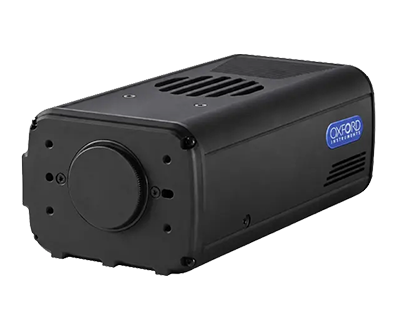
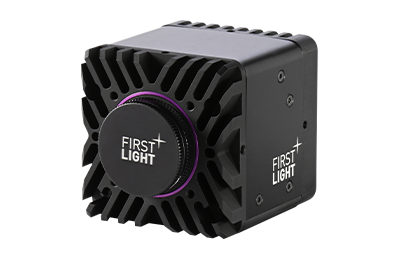
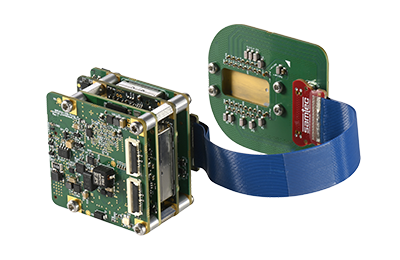
C-RED 2 is a revolutionary ultra high speed low noise Short Wave Infrared camera, able to run at 600 fps with less than 30 electrons readout noise.To achieve this performance, C-RED 2 integrates a 640 x 512 InGaAs PIN Photodiode detector with 15 μm pixel pitch for high resolution, which embeds an electronic shutter.
NEW! C-RED 2 VIS-SWIR now available!

High speed & low noise
Its high frame rate up to 600 FPS full frame and its low readout noise < 30 e- makes it optimal for applications where speed matters.

On-head corrections
Special modes (Tunings and dark optimisation) directly act on the sensor to operate the camera in the best conditions.

Low dark current
Versatile, the camera is also designed to detect faint signals. With its dark current <600 e/p/s, the signal to noise ratio is preserved.

Compact
Designed to be integrated in constrained places, its volume is only (L x W x H in mm) 142.5 x 74.9 x 55.0 mm3 with a weight of 900 g.
A versatile camera optimised for speed and long exposures, with excellent low-light performance.
The Extended Range variant enables the detection of wavelengths up to 2200 nm.
From visible to SWIR wavelengths, we cover two spectral ranges in one
camera.
The table below summarises the key technical specifications for the C-RED 2 Series, providing a side-by-side comparison of sensor format, spectral range, cooling performance and operational characteristics.
| Model | C-RED 2 | C-RED 2 ER 1.9 µm | C-RED 2 ER 2.2 µm | C-RED 2 VIS-SWIR |
| Sensor size (pixels) | 640 x 512 | |||
| Pixel pitch (µm) | 15 | |||
| Maximum speed Full Frame (fps) | 600 | |||
| Peak Quantum Efficiency (%) | 80 | 82 | 85 | 82 |
Image Full Well Capacity (ke-)
low gain
med gain
high gain
|
1400 | 1500 | 1400 | |
| 128 | 130 | 118 | ||
| 33 | 34 | 33 | ||
| Read Noise at high gain, Tint at 50 µs, 600 fps Full Frame | @ -40°C 23 e⁻ rms (typical)*1 28 e⁻ rms (max.) |
@ -40°C 32 e⁻ rms (typical) 40 e⁻ rms (max.) |
@ -55°C 36 e⁻ rms (typical) 40 e⁻ rms (max.) |
@ -55°C 25 e⁻ rms (typical) |
| Dark Current | @ -40°C 365 e⁻/p/s (typical)*1 600 e⁻/p/s (max.) |
@ 20°C 19.5 ke⁻/p/s (typical)*1 20.5 ke⁻/p/s (max.) |
@ 20°C 139 ke⁻/p/s (typical)*1 210 ke⁻/p/s (max.) |
@ 20°C 900 ke⁻/p/s (typical)*1 |
1. For C-RED 2 model typical refers to the median value from a large set of cameras.
Spectral signatures in the SWIR region can provide unique optical, structural or electronic information for certain classes of material & chemical species. Relevant analytical techniques inc. Fluorescence, Photoluminescence, Cathodoluminescence, Raman and Reflectance/Transmittance spectroscopies.
Visible cameras have been used for a very long time in astronomy, and now, Short Wave Infrared (SWIR) cameras are opening the path to new observations and discoveries. Unlike light at visible wavelengths, infrared light is not blocked by interstellar dust. Astronomers use SWIR cameras to study the J-band (1.1 – 1.4 µm), H-band (1.5 – 1.8 µm ) and K-band (2.0 – 2.4 µm). One of the major applications of our cameras in astronomy is adaptive optics: the active correction loop used to reduce the atmospheric disturbances that cause spatial and temporal distortions.
Short Wave Infrared (SWIR) imaging is often referred to as NIR-II imaging in the life science community. Thanks to low scattering and low tissue autofluorescence in this range, NIR-II imaging allows deep, non-invasive, high-resolution detection of in vivo or ex vivo tissues. With the recent and growing development of contrast agent and dyes that emit at higher wavelength, more and more applications can be targeted. A further extended spectral range 1600 – 1870 nm optimises the scattering and absorption of tissues, hence the penetration depth of light in tissues and is ideal for deep brain imaging. Other applications such as Optical Coherence Tomography (OCT) will also benefit from the longer penetration depth of light.
The camera’s combined visible and SWIR sensitivity enables enhanced inspection of semiconductor materials and devices by revealing features that are difficult or impossible to detect with conventional visible imaging. SWIR imaging can penetrate silicon, allowing non-destructive inspection of die structures, wafer alignment, packaging integrity, and defect localization through silicon substrates. The simultaneous capture of visible and SWIR information improves defect detection, process monitoring, and quality control throughout semiconductor manufacturing workflows. This capability supports higher yield, faster failure analysis, and more reliable production in advanced semiconductor processes.
Spectral signatures in the SWIR region can provide unique optical, structural or electronic information for certain classes of material & chemical species. These include biomarkers, biosensors and functionalised molecules for bio-imaging in the NIR II region (e.g. carbon nanotubes, rare-earth nanoparticles, quantum dots, …), integrated quantum sources in telecom bands, high-efficiency photovoltaic structures & photodetectors, or catalysis and reactions mechanism study/real-time monitoring. Relevant analytical techniques including: Fluorescence, Photoluminescence, Cathodoluminescence, Raman and Reflectance/ Transmittance spectroscopies.
Andor’s C-RED series delivers high-speed SWIR imaging without compromising sensitivity or image quality. Combining low noise, high dynamic range, and rapid frame rates, these advanced InGaAs cameras enable precise detection and analysis of dynamic phenomena across applications including astronomy, adaptive optics, laser diagnostics, industrial inspection, and scientific research.
Learn More

© Oxford Instruments 2026
 Powered by Bioz
