Resources
 Part of the Oxford Instruments Group
Expand
Collapse
Part of the Oxford Instruments Group

Buyers' Guides
Author: Judith Beer
Published: 03 Aug 2026 · Last updated: 06 Aug 2026
Fluctuating environmental conditions and vibrations can have a significant impact on image quality, reproducibility and experimental success in fluorescence microscopy. Especially long-term studies, live-cell experiments, high-resolution imaging, and automated imaging workflows require mechanical stability and careful control of environmental conditions such as temperature and humidity.
Different microscope designs offer varying levels of vibration reduction and environmental regulation. This overview explains the most common solutions on vibration and environmental control and highlights key considerations when selecting a system.
Stable mechanical conditions ensure the acquisition of sharp, reproducible images, particularly during long time-lapse, Z-stack, 3D, or high-resolution imaging experiments. Depending on the imaging modality used and the vibration profile of your laboratory environment, vibration-minimising features can be critical.
While widefield fluorescence imaging, especially at lower magnifications, often does not require dedicated vibration control, confocal and super-resolution imaging are more sensitive to mechanical disturbances and need vibration-reducing measures.
| Configuration | Description |
| Passive vibration control |
|
| Active vibration control |
|
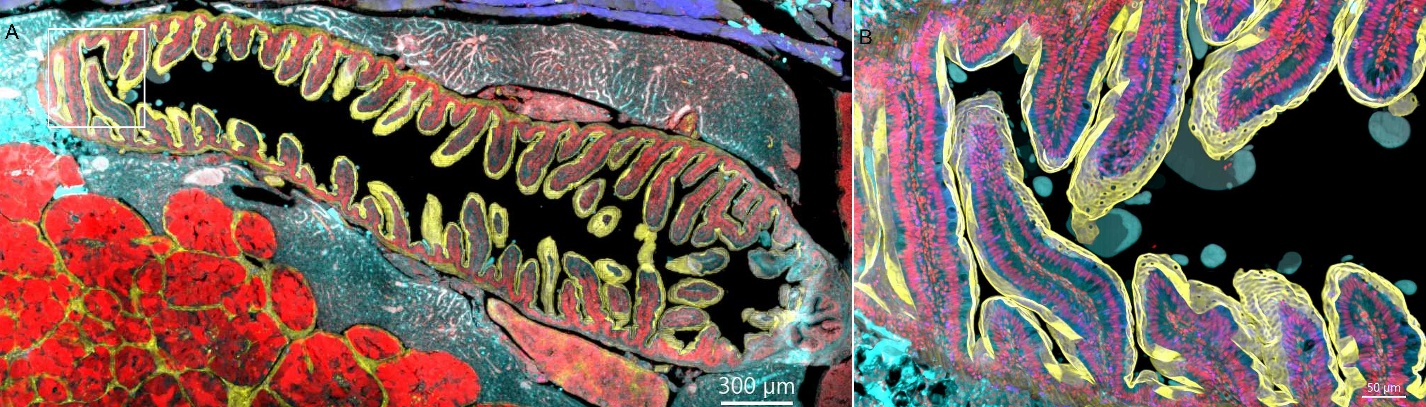
Fig. 1 — Stitched image of zebrafish intestine. The image was acquired using the confocal imaging modality of the BC43 system, employing 4 imaging channels, 77 z-stacks, and 28 tiles. The final stitched image comprises a total of 15,092 individual images, yet appears as a single seamless snapshot. This high-quality stitching is achieved through Borealis's uniform illumination, robust anti-vibration design, and the Imaris Stitch algorithm. (A) Full view of the intestine section. (B) Zoomed-in view highlighting structural details of the intestinal tissue. Both deconvolution and stitching options were enabled during acquisition. Sample courtesy of Julien Resseguier, NorMic, University of Oslo. Image credit: Claudia Florindo, Oxford Instruments.
Maintaining stable environmental conditions is essential for reliable and reproducible imaging, particularly when working with live cells or long time-lapse experiments. Fluctuations in temperature, gas composition, humidity, or mechanical stability can introduce image drift and directly affect cell physiology.
Benchtop fluorescence microscopes differ considerably in the level of environmental control they provide. Enclosed (boxed) systems naturally reduce exposure to ambient environmental variations compared with open-frame designs. However, for specific applications such as live-cell and long-term imaging, environmental control solutions are required.
| Configuration | Description |
| Integrated environmental control |
|
| Stage-top incubators |
|
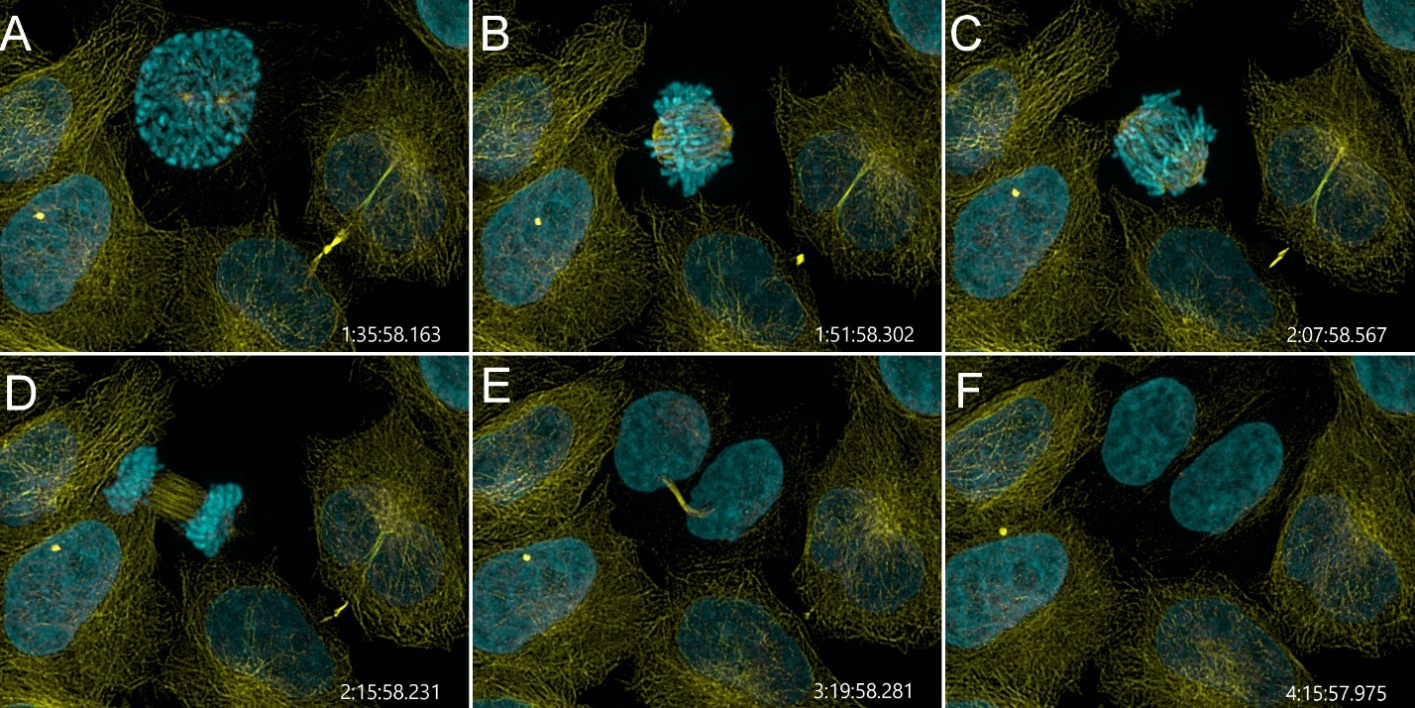
Fig. 2 — Visualising mammalian cell division with BC43. Time lapse image acquired every 3 min, using the confocal imaging modality. Cells were incubated at 37°C, Yellow: microtubules; cyan: DNA. Image credit: Ines Baião-Santos and Álvaro Tavares, Universidade do Algarve, Claudia Florindo, Oxford Instruments.
Learn more about the key technologies, components and practical considerations involved in selecting a benchtop fluorescence microscope.

© Oxford Instruments 2026