Resources
 Part of the Oxford Instruments Group
Expand
Collapse
Part of the Oxford Instruments Group

Buyers' Guides
Author: Judith Beer
Published: 03 Aug 2026 · Last updated: 06 Aug 2026
The microscope stage determines how samples are scanned and revisited throughout an experiment. Stage size, motorisation, positioning precision, and compatibility with environmental control units directly influence the type of experiments that can be performed.
While benchtop systems typically include motorised control in XY and Z, performance, accuracy, and flexibility can vary between models.
This overview compares stage types commonly used in benchtop microscopes and highlights the key factors to consider when evaluating a system.
| Stage Type | Characteristics |
| Manual stages |
|
| Motorised stages |
|
| Piezo stages |
|
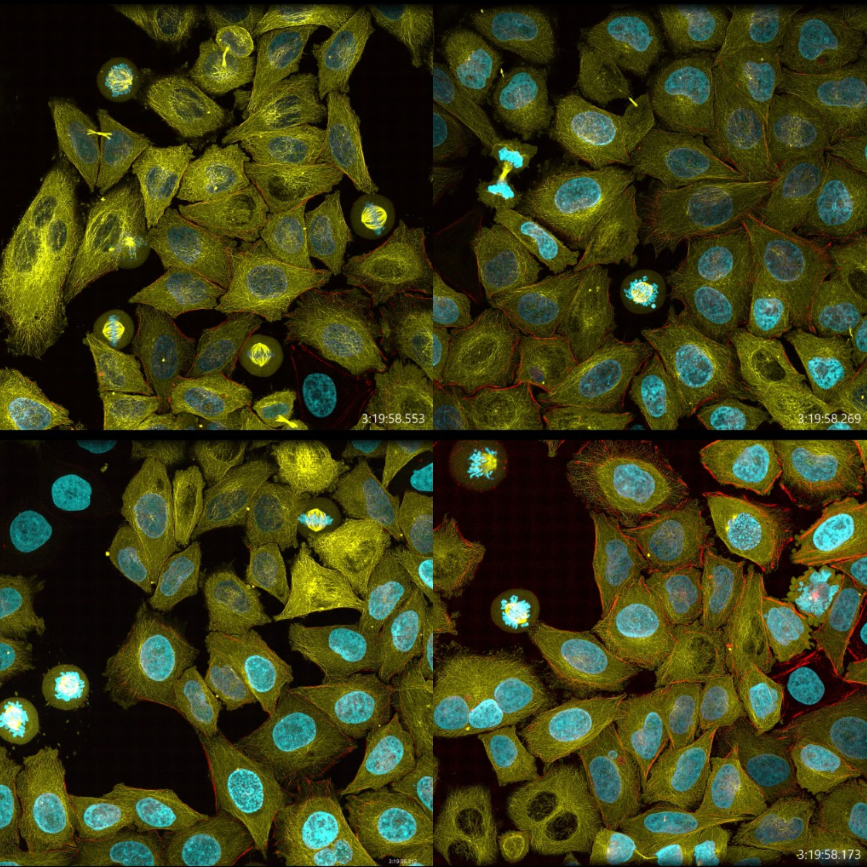
Fig. 1 — Multi-position imaging of mammalian cells with BC43 using confocal imaging mode over 4 hours. At each time point, 4 independent positions were imaged with 3 channels and 15 Z stacks per position. The focus Seek & lock mechanism maintained focus while navigating between positions. Image credits: Ines Baião-Santos, Álvaro Tavares – Universidade do Algarve; Claudia Florindo – Oxford Instruments.
Learn more about the key technologies, components and practical considerations involved in selecting a benchtop fluorescence microscope.
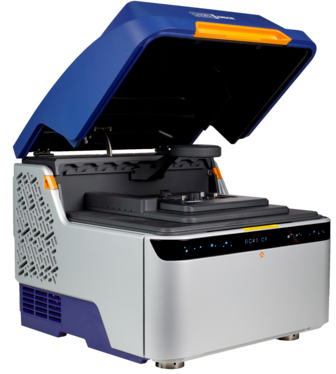
BC43 features a fully motorised, software-controlled XY and Z stage with high positional accuracy. It is suitable for demanding applications including tile scanning, 3D imaging, multi-position workflows, and long-term time-lapse experiments.

© Oxford Instruments 2026