Resources
 Part of the Oxford Instruments Group
Expand
Collapse
Part of the Oxford Instruments Group

Author: Judith Beer
Published: 03 Aug 2026 · Last updated: 06 Aug 2026
The microscope chassis (body) defines the system's overall architecture and strongly influences sample compatibility, environmental stability, illumination setup, and workflow integration. While it does not usually dominate the total system cost, it determines many practical aspects of usability, flexibility, and overall imaging performance.
This overview explains the microscope architectures and design choices found in benchtop systems and highlights the key factors to consider when evaluating a microscope.
| Configuration | Description |
| Upright microscopes |
|
| Inverted microscopes |
|
| Configuration | Description |
| Open-framed microscopes |
|
| Enclosed/boxed microscopes |
|
| Configuration | Description |
| Eyepiece-based systems |
|
| Digital-only systems |
|
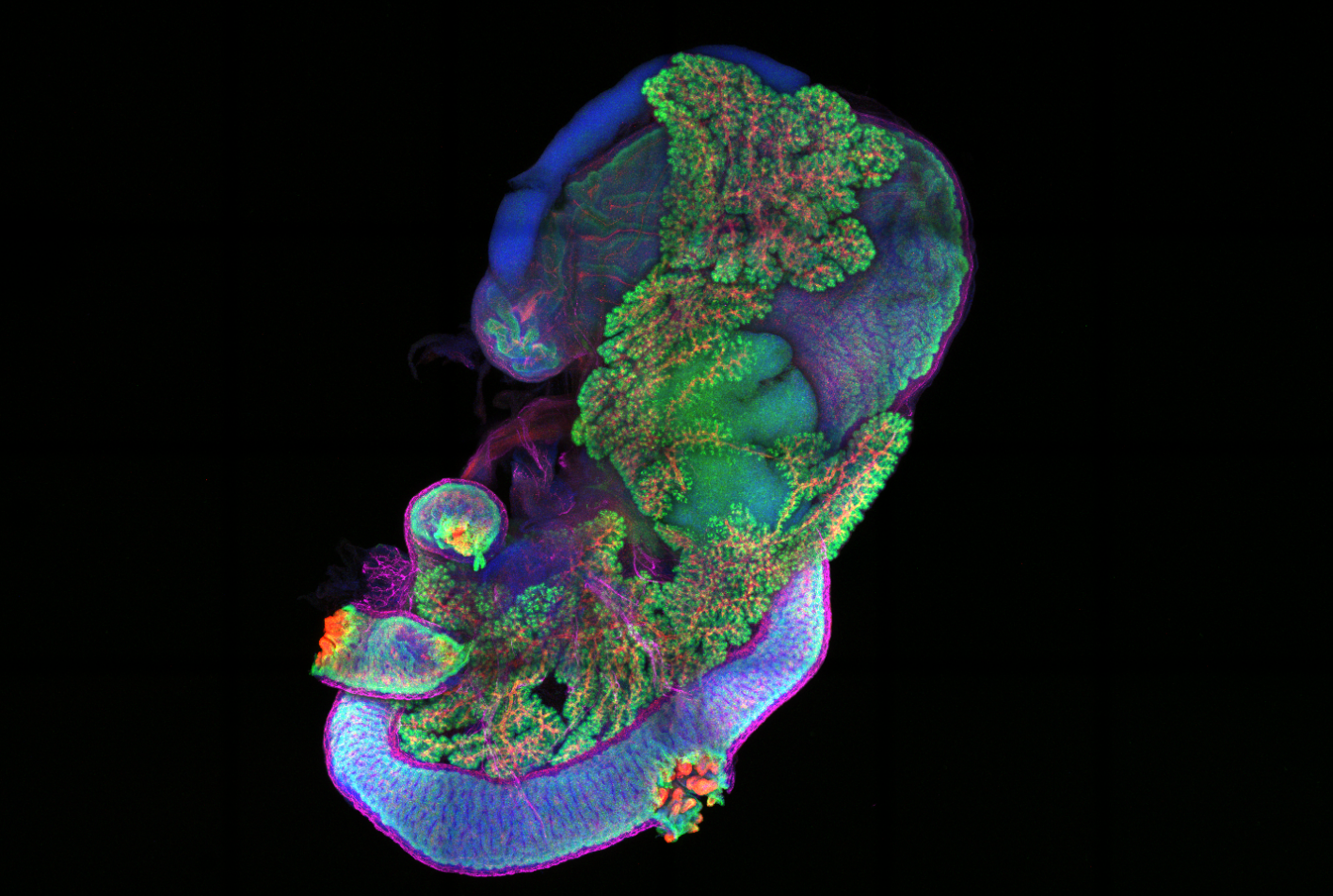
Fig. 1 — Mouse pancreas and connected tissues imaged with BC43. Whole-mount immunofluorescence staining of a whole E16 mouse pancreas, with the spleen, stomach and duodenum intact, enabling further investigation of the anatomical characteristics in pancreatic development and disease. The tissue was imaged using a confocal microscope by tiling and processed using Imaris. Image courtesy of Cedric Yu, PhD, University of California, San Francisco.
Learn more about the key technologies, components and practical considerations involved in selecting a benchtop fluorescence microscope.
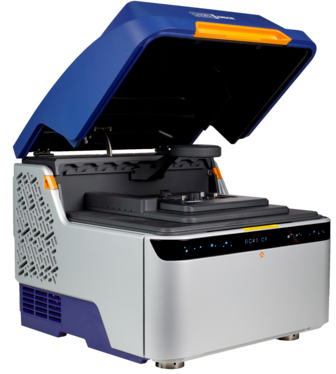
BC43 is a fully digital, enclosed microscope with an inverted beam path. It enables intuitive sample navigation using a 2x objective, while the integrated high-QE sCMOS camera supports sensitive and fast imaging across a wide magnification range, including high-magnification imaging up to 100x

© Oxford Instruments 2026