
Resources
 Part of the Oxford Instruments Group
Expand
Collapse
Part of the Oxford Instruments Group

Technical Articles
Author: Kevin Nott
Published: 15 Jun 2026 · Last updated: 18 Aug 2026
Tags: Time-Domain NMR, spectroscopy techniques, NMR Spectroscopy, Nuclear Magnetic Resonance
Time-domain nuclear magnetic resonance (TD-NMR) is a low-field NMR technique that is commonly used in quality assurance and quality control (QA/QC) across food, agriculture, petroleum, polymer and other industries. It enables fast and robust measurements of oil, water, solid, and hydrogen/fluorine content, as well as various physical properties such as crystallinity.
Beyond routine QA/QC, TD-NMR is increasingly used in academic and industrial research for a broad range of measurements to characterise food, pharmaceuticals, cement, and other porous media.
This article outlines the characteristics and specific advantages of TD-NMR and compares it with other established analytical techniques such as NMR spectroscopy or other physiochemical methods.
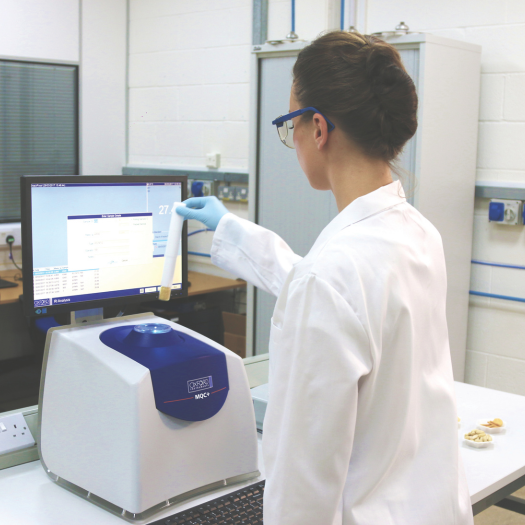
Despite being based on the same principles, there are various practical differences between TD-NMR and NMR spectroscopy:
| Benchtop NMR Spectroscopy | Time Domain NMR* | |
| Instrument(s) | X-Pulse 60/90 | MQC+23, MQC-R, MQC+5 |
| Field strength | >1.45 Tesla | < 0.55 Tesla |
| 1H frequency | 60 MHz | < 23 MHz |
| Nuclei | 1H, 19F, 13C, 31P (11B, 7Li, 23Na, 29Si …) | 1H and 19F |
| Sample diameter | 4-5 mm | 10-26 mm (MQC+23, MQC-R) 40-51 mm (MQC+5) |
| Line width (homogeneity) | ppb | ppm |
| NMR spectra acquisition | Yes | No |
| Sample state | Liquid/Solution | Solid/Liquid/Paste |
| Structural elucidation (of simple low mass compounds); Quantitative analysis (using peak areas); Qualitative analysis (spectral fingerprinting); Reaction monitoring (variable temperature 0-65°C, flow); Diffusion and imaging | Hydrogen/Fluorine content; Oil/Fat & Moisture content; Solid Fat Content (SFC); Amorphous/Crystalline content MQC-R only: Mobility and structure (e.g. pore size), diffusion, droplet size and imaging |
*Also known as TD-NMR, low-resolution and low-field NMR. The term “low-field NMR” is sometimes used for Benchtop NMR Spectroscopy.
TD-NMR relaxometry experiments can provide information complimentary to that obtained from solid-state high-field NMR experiments, typically performed on a superconducting magnet. Key advantages include simpler experimental protocols and reduced sample preparation.
Since relaxation times depend on magnetic field strength, TD-NMR is sensitive to slower molecular motions that are not accessible at high field. In addition, low-field TD-NMR is less affected by spectral line broadening in heterogeneous or susceptibility-varied samples such as food, biological tissues and porous media (e.g. concrete). As a result, clean relaxation data can be obtained without the need to acquire and interpret NMR spectra.
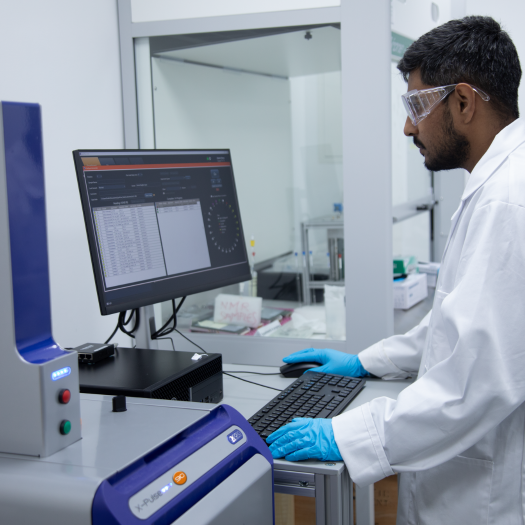
Most TD-NMR methods used in QA/QC are intended to replace wet chemical methods, which are time-consuming, labour-intensive, and require skilled operators. In addition to routine applications, TD-NMR offers a range of capabilities for research that complement, and in some cases replace, established material characterisation techniques.
| Measurement | Alternative techniques | Advantages of NMR |
| Composition | Solvent extraction, drying | Measurement without sample alteration, no chemicals needed |
| Phase transitions | Thermal (e.g. Differential Scanning Calorimetry) | Non-invasive; non-destructive |
| Pore size distribution | X-Ray CT, N2 adsorption, BET and mercury-porosimetry | Faster, easier and safer; no consumables needed |
| Mass transport (diffusion, ingress and separation) | UV/visible spectroscopy (of dye), Optical (fluorescent molecules), Electrochemical (in solution) | Applicable to solids and liquids; Direct detection of water (hydration/drying) and other 1H (or 19F) containing liquids |
TD-NMR is a suitable alternative to solvent extraction and drying methods for compositional analysis. While conventional chemical techniques often require hazardous reagents and permanently alter the sample, TD-NMR characterises and quantifies 1H and 19F- containing components directly and non-invasively.
Thermal methods are widely used to measure phase transitions but are restricted in the type of information they provide and typically destroy the sample. In contrast, TD-NMR is non-destructive and is routinely applied to measure phase transitions in food (e.g. fat melting, water freezing), pharmaceuticals (amorphous/crystalline transition), polymers (glass transition), and more.
TD-NMR offers unique advantages for samples containing water, as water acts as the signal source and not as an interference. This enables direct monitoring of hydration and dehydration processes in a variety of different samples, such as agriculture-food products, pharmaceuticals, and building materials.
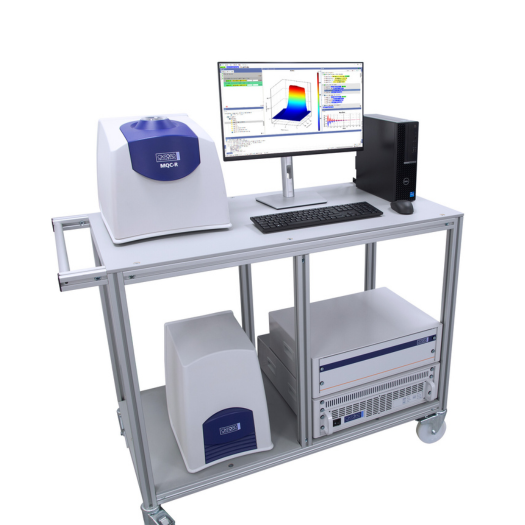
TD-NMR also uses water as a probe molecule to measure pore size distributions in cementitious materials and rocks. It can resolve pore size, surface-to-volume ratio and connectivity under real world conditions, it however requires saturation with water or another solvent. TD-NMR provides additional insights into bound and interlayer water, which makes it a suitable method for linking structure, chemistry, and dynamics at solid-liquid interfaces.
The information obtained with TD-NMR is complementary to that from other techniques. X-ray computerised tomography (CT) visualises solid structure rather than porosity. N2 adsorption measures pore size distribution in the micro- and meso-pore regime, while BET (Brunauer–Emmett–Teller) analysis derives specific surface area from the same data. Mercury porosimetry measures pore size distribution in the meso- and macro-pore regime along with other related parameters but requires high pressure and toxic mercury.
Mass transport analysis often relies on tracers, for example UV/visible or fluorescence spectroscopy using dyes. These approaches probe transport indirectly and are often limited to transparent, liquid systems or to conductive samples in electrochemical methods.
TD-NMR provides the unique capability to directly measure diffusion and mass transport without using tracers, particularly for water, fat or fluorine-containing species in solids, liquids and heterogeneous materials. By measuring restricted diffusion, TD-NMR links molecular mobility to structural length scales, enabling for example the easy assessment of water and fat droplet sizes in emulsions.
TD‑NMR directly measures hydrogen and fluorine nuclei. This provides several unique capabilities that are difficult to achieve with other chemical, thermal, or optical techniques:
Direct, quantitative water, fat and fluorine measurement
Non‑destructive and non‑invasive
Applicable to opaque and heterogeneous materials
Sensitive to phase changes involving water
Direct measurement of mass transport and diffusion
Fast measurements and minimal sample preparation
Together, these features make TD‑NMR uniquely well suited to both research and routine quality control applications across a wide range of materials, where many other techniques struggle or introduce artefacts.

© Oxford Instruments 2026