
Resources
 Part of the Oxford Instruments Group
Expand
Collapse
Part of the Oxford Instruments Group

Application Notes
Author: Robin J Blagg
Published: 06 Oct 2026 · Last updated: 06 Oct 2026
Battery electrolyte decomposition can alter chemical composition over time and produce by-products that impact battery performance. This Application Note demonstrates how the Oxford Instruments X-Pulse 90 benchtop NMR spectrometer can be used to detect and monitor battery electrolyte degradation on the example of Li[PF₆]-based lithium-ion batteries. Using ¹⁹F and ³¹P NMR measurements, signals from the original [PF₆]⁻ anion and several decomposition products can be clearly distinguished. A separate time-resolved experiment resolved water-induced Li[PF₆] hydrolysis using ¹⁹F spectra acquired over 22 hours, with further changes observed after 15 days. The results show how multinuclear benchtop NMR can support electrolyte stability studies, formulation development, manufacturing quality control and battery failure analysis.
Lithium-ion (Li-ion) batteries have become ubiquitous in daily life, providing power for a diverse range of applications, ranging from mobile phones, computers, power tools, and medical devices to the green technologies including electric cars and solar energy storage. As our usage of lithium-ion batteries has grown, so has the need to optimise their performance and to ensure reliability over a long lifetime. At the same time new technologies including sodium-ion (Na-ion) batteries are in development.
Electrolytes play a crucial role in the performance and reliability of Li-ion batteries, providing the medium that allows anions and cations to carry charge between the electrodes, as shown in Figure 4.1. In the current generation of commercial batteries, the electrolyte is typically made up of organic small-molecule liquid solvents, commonly a mixture of alkyl carbonates, combined with a lithium salt. Additionally, various additives are used to ensure specific chemical and electrochemical properties.
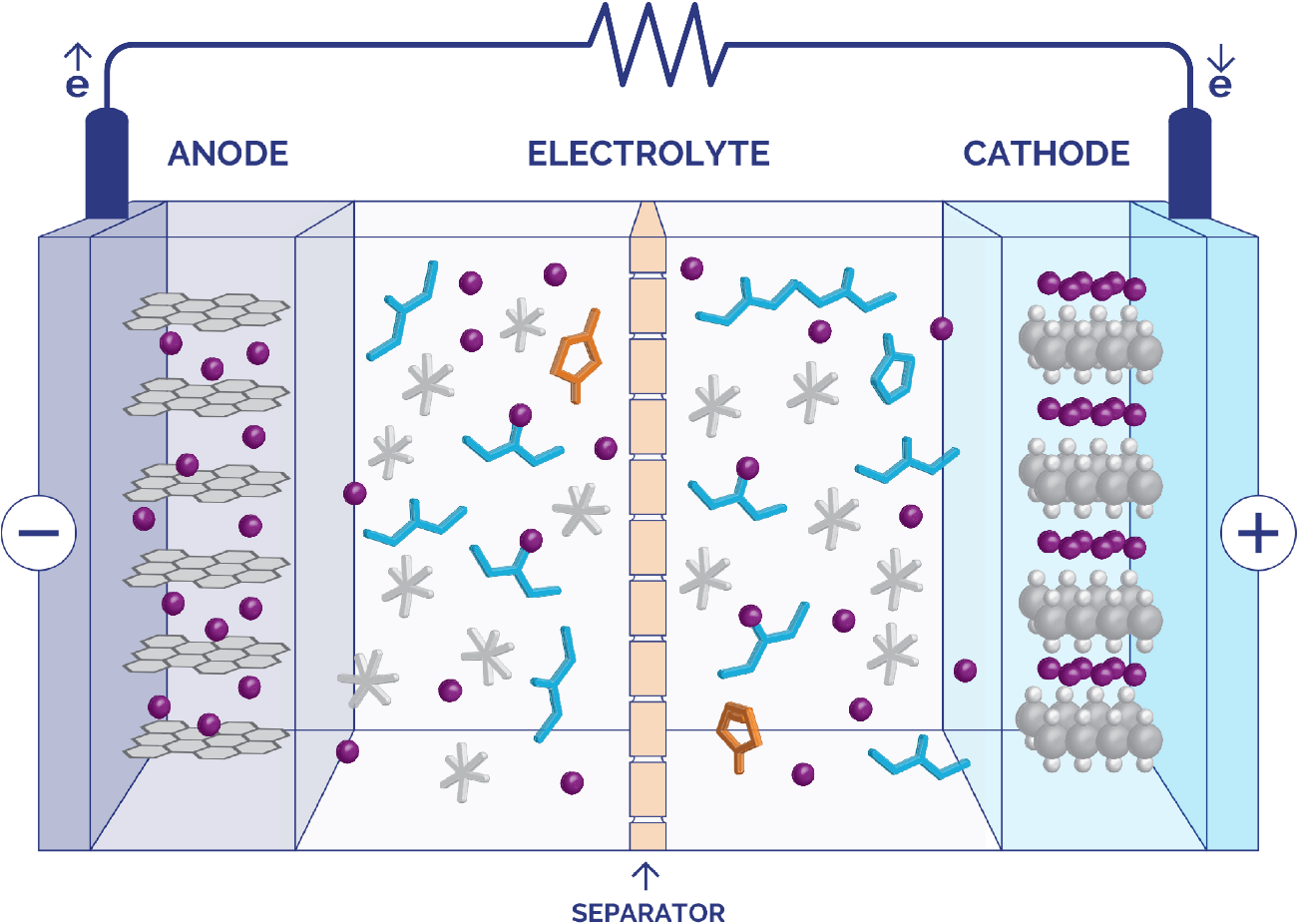
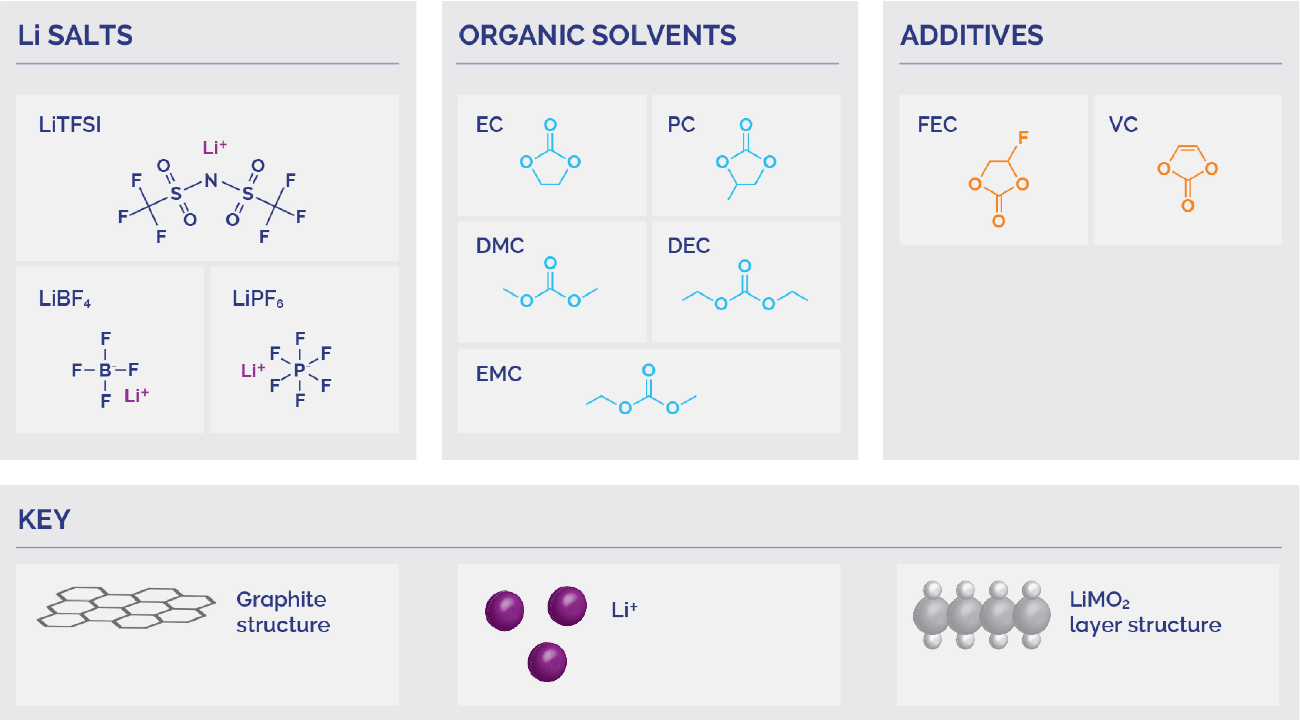
Figure 4.1 Diagram of a lithium-ion battery, showing major components including the anode, cathode, separator, and electrolyte.
While lithium-ion batteries have played a major role in transforming our daily lives, benchtop NMR spectroscopy has similarly begun to revolutionise quality assurance and quality control (QA/QC) processes by making a powerful technique easier and more accessible for routine analysis in any laboratory. Benchtop NMR has many potential lithium-ion battery QA/QC applications, as the well-resolved spectra of the small organic molecules and ions are ideally suited for quick, convenient analysis.
The Oxford Instruments X-Pulse broadband benchtop NMR spectrometer (available with a 60 MHz or 90 MHz permanent magnet) provides significant advantages for the development and analysis of battery electrolytes. Since a single broadband X-Pulse instrument can analyse all the NMR-active nuclei commonly found in Li-ion (and Na-ion) batteries, including 1H, 19F, 13C, 31P, 11B, 7Li and 23Na, this allows for the results of electrolyte aging and decomposition to be observed using the most appropriate nuclei for the species of interest.
There are three main causes of decomposition / degradation of Li-ion battery electrolytes:
Understanding these processes is important to understand how battery performance changes over time.
By obtaining 19F and 31P NMR spectra of an old sample of Li[PF6]-based battery electrolyte (Figures 4.2 & 4.3), we can readily identify signals arising from the decomposition of the electrolyte. We can also quantify that the total amount of decomposed species correspond to less than 1% the amount of [PF6]− still present.
The 19F spectrum shows four additional signals: one sharp peak at −156 ppm can be assigned as ‘free’ hydrogen fluoride. Three signals in the range −78 to −94 ppm, which each appear as two sharp peaks, due to coupling to a single phosphorus atom, can be assigned as OPF2(OR) where R = H, Methyl, Ethyl. The presence of methyl and ethyl functionalities in the decomposition products suggests that not only the [PF6]− anion but also the alkyl carbonate solvent is decomposing (this sample was a mixture of ethylene carbonate and ethyl methyl carbonate).
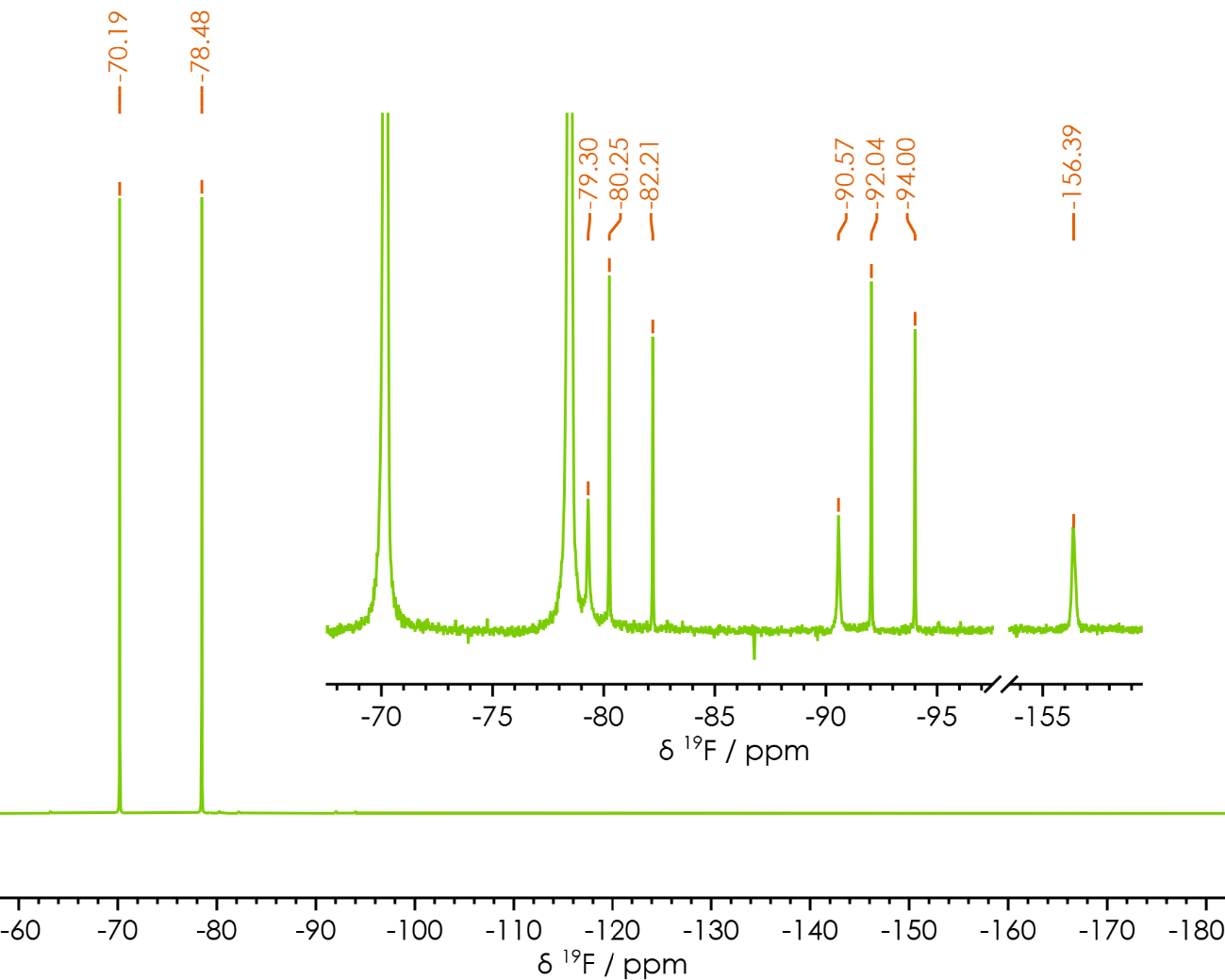
Figure 4.2 19F NMR spectrum of an old sample of Li-ion battery electrolyte. Insert showing baseline expanded ca 200 time.
These assignments are supported by the 31P{1H} spectrum, where in addition to the septet from the [PF6]−, three triplets are observed in the +10 to −50 ppm region, each arising due to coupling to two equivalent fluorine atoms. The magnitude of the J-couplings match those observed in the 19F spectrum.
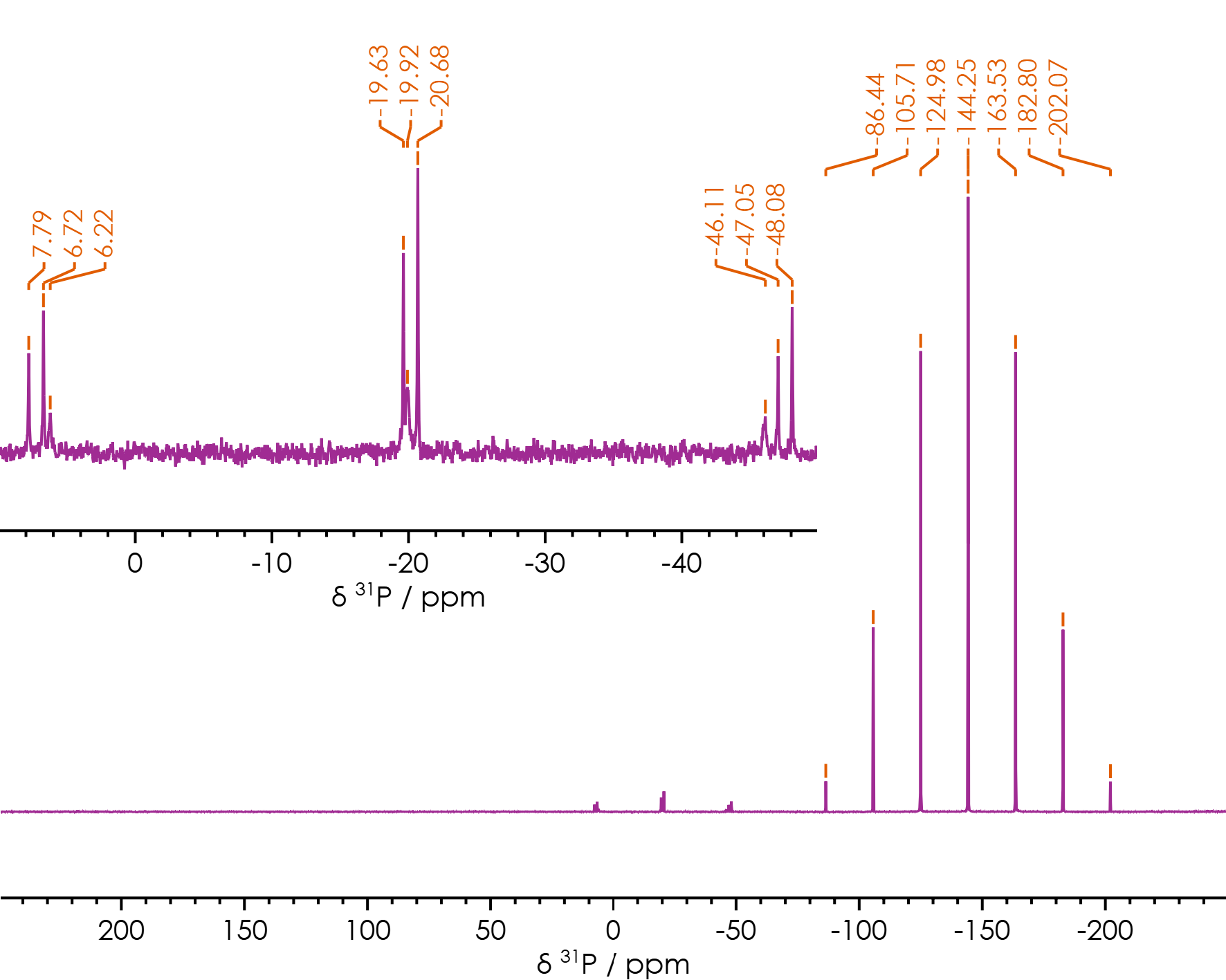
Figure 4.3 31P{1H} NMR spectrum of an old sample of Li-ion battery electrolyte. Insert showing expansion of OPF2(OR) signals
Since chemical shift (in ppm) and the magnitude of J-coupling (in Hz) is independent of the field strength of the magnet, these signals can be identified by comparison with reference values, such as those shown in Table 4.1.
Table 4.1 Reported 19F & 31P chemical shifts & J-coupling constants for products of the (thermal) decomposition of Li[PF6] in EC/DMC/DEC mixtures [1]
| δF / ppm (multiplicity) | δP / ppm (multiplicity) | JFP / Hz | |
| Li[PF6] | −73.0 (d) | −145.0 (sept) | 709 |
| OPF3 | −88.6 (d) | −35.7 (q) | 1068 |
| OPF2(OEt) | −84.9 (d) | −20.5 (t) | 1008 |
| OPF2(OMe) | −86.8 (d) | −20.1 (t) | 1008 |
| OPF2(OH) | −83.6 (d) | −19.6 (t) | 970 |
| OPF(OEt)2 | −82.0 (d) | −9.6 (d) | 962 |
| OPF(OMe)2 | −86.6 (d) | −8.4 (d) | 961 |
| OPF(OMe)(OEt) | −84.3 (d) | −10.8 (d) | 963 |
| OPF(OH)2 | −76.5 (d) | −10.0 (t) | 933 |
| HF | ca −155 (s) | - | - |
| LiF | ca −187 (s) | - | - |
| EtF | −211.43 (tq) | - | - |
| MeF | −268.34 (q) | - | - |
Under most circumstances, decomposition of Li-ion battery electrolytes will take place over months or even years. By intentionally accelerating the decomposition process, it can be directly monitored using benchtop NMR spectroscopy.
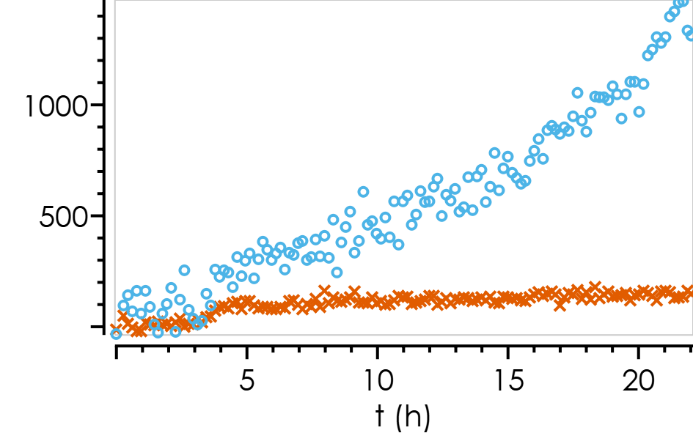
In this example, a sample of Li[PF6] in a mixture of EC/DMC is transferred into a standard NMR tube with a PTFE liner. The liner prevents any hydrogen fluoride, HF, that can be formed as a possible product from the decomposition of [PF6]− from reacting with the borosilicate glass of the NMR tube. After optimising the instrument and acquiring an initial 19F spectrum, 2% H2O was added to the NMR tube, the sample reinserted into the spectrometer, and a 19F spectrum was acquired every 10 minutes of a 22 hour period.
Analysis of the resulting data (Figure 4.4) showed the formation of two new species over that period:
The reaction had not reached completion after the 22 hours.
![19F NMR spectra of Li[PF6] over 22h](/learning/uploads/inline-images/docx-img-20261006070502-6aadb9a9.png)
Figure 4.4 19F NMR spectra of Li[PF6] in EC/DMC acquired over 22 hours following the addition of 2% (v/v) H2O
After a total of 15 days reaction time, another 19F NMR spectrum was acquired (Figure 4.6) demonstrating how the reaction has progressed. In addition to the difluorophosphoric acid, OPF2(OH), observed initially, there are three new signals, all appearing as doublets, with the major reaction product corresponding to fluorophosphoric acid, OPF(OH)2, (δF −77.3 ppm, 1JFP 930 Hz). The lithium fluoride signal at δF −190 ppm is also now much sharper that it appeared initially.
![19F NMR Spectra of Li[PF6] after 15 days](/learning/uploads/inline-images/docx-img-20261006070502-fee81875.png)
Figure 4.5 19F NMR spectra of Li[PF6] in EC/DMC acquired 15 days following the addition of 2% (v/v) H2O
The X-Pulse 90 and X-Pulse 60 broadband benchtop NMR spectrometers are ideal tools for analysing the aging and decomposition of lithium-ion battery electrolyte. In this Application Note, we’ve demonstrated how degradation of lithium hexafluorophosphate based electrolytes can readily be observed by benchtop NMR spectroscopy, both through the analysis of aged samples, or by directly monitoring the decomposition process following the addition of water to an electrolyte sample. This demonstrates the value of the X-Pulse family of broadband NMR spectrometers, not just for the initial development of Li-ion battery electrolytes, but also for QC/QA of batteries during manufacturing, and failure analysis of batteries in the field.
[1] C. L. Campion, W. Li and B. L. Lucht, J. Electrochem. Soc., 2005, 152, A2327, DOI: 10.1149/1.2083267.

© Oxford Instruments 2026