Laser Safety
| Caution |
|---|

Read and do not ignore! Caution - Use of controls or adjustments or performance of procedures other than those specified herein may result in hazardous radiation exposure. |
This product contains lasers, so you must be aware of the hazards associated with the use of the powerful laser radiation that can be emitted by this product.
-
Laser radiation is emitted by this product when the Emission Indicator LEDs are illuminated.
-
WARNING: As defined in IEC 60825-1, this product is Class 3B, which means that it is hazardous to the eyes. If the power approaches the Class 3B AEL and the radiation is concentrated sufficiently, it potentially could cause a fire.
-
Extreme caution must thus be taken with the laser radiation emitted from this product.
-
Be conscious of the path taken by the beam emitted by this product or any attached product.
-
Do not expose any part of your body to the laser radiation emitted by this product or any attached product.
-
Skin damage or deeper injury can be caused by lasers, but the eye is especially susceptible as laser light can be collimated into a narrow beam that can enter the eye and permanently damage the retina with life-changing consequences.
-
The following labels summarise the same information and are located on the front panel of the main unit:
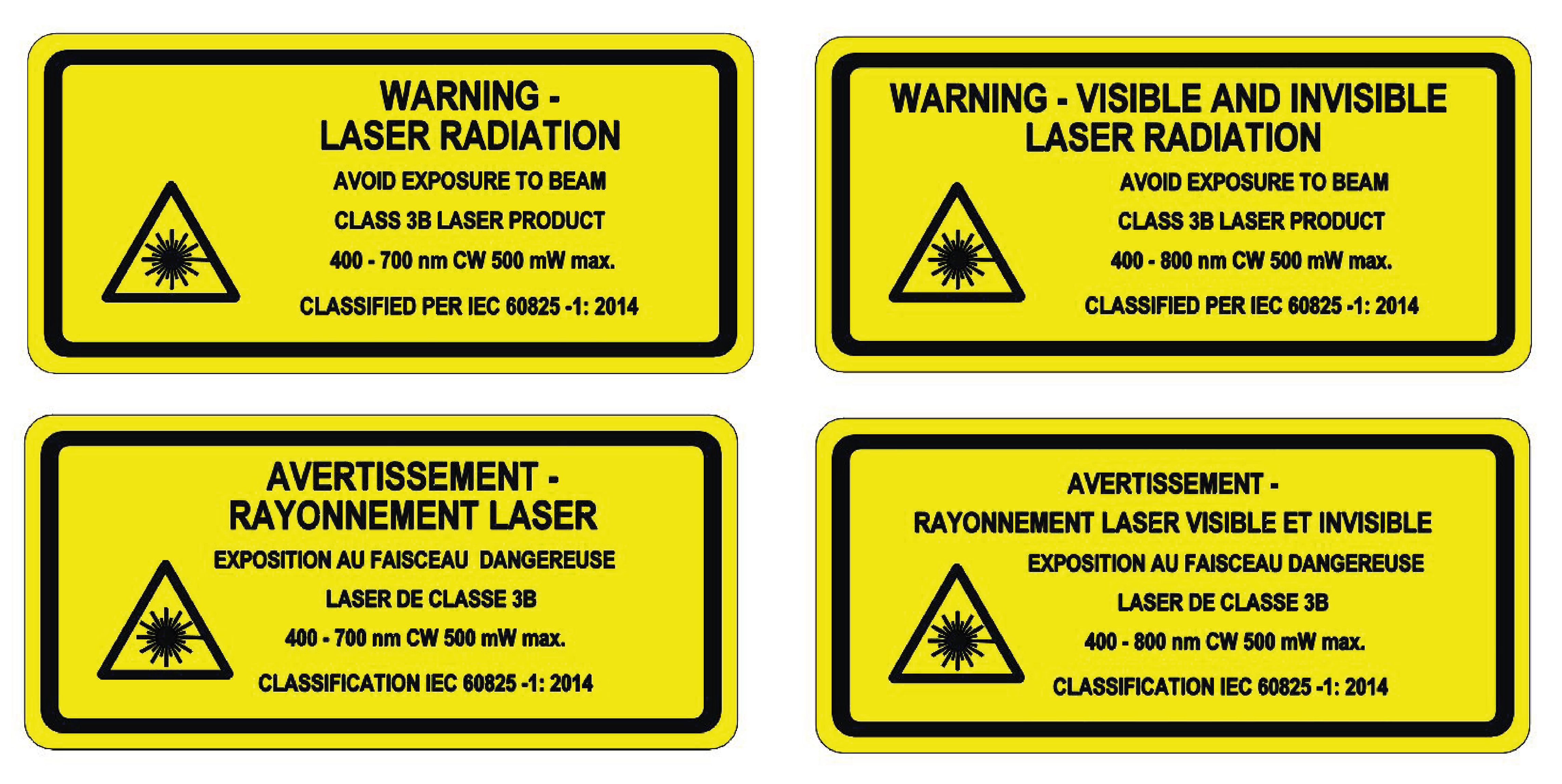
Versatile Laser Engine Class
-
The power indicated on this product would be very tame if it was a light bulb, but this should not deceive you as laser radiation is quite different.
-
Laser radiation differs from ordinary light primarily because its optical power can be concentrated into a narrow, low-divergence beam, whereas, for example, a standard light bulb diffuses its light in all directions and thus spreads out its power. It’s a bit like the difference between walking outside on a sunny day versus having the sun’s light concentrated on your skin using a magnifying glass.
-
Laser safety for this type of product is about reducing risk, rather than being able to eliminate it because access is usually required for the applications that it is typically purchased for, so it is not completely safe.
-
Be aware that visible laser light is dangerous as well as invisible.
-
Be aware that this product may emit invisible laser radiation outside the visible spectrum of 400 nm – 700 nm, which has the added danger that it cannot be seen. If you have such lasers, we advise that you purchase fluorescent cards that assist with observing the presence of the wavelength(s) of invisible laser radiation emitted by this product and that you use them safely.
-
All lasers in this product are CW (Continuous Wave), are generated using laser diodes, are confined to a very narrow bandwidth and may have very narrow, low-divergence beams, depending on the application.
-
It is important to remember to beware reflections from objects such as tools or clips placed close to the laser beam emitted from the microscope objective.
-
One of the primary means of protection is protective housing, which as IEC 60825-1 says, “prevents human access to [hazardous] laser radiation (including errant laser radiation) except when human access is necessary for the performance of the function(s) of the product.”
-
As a user of a product that allows considerable access to hazardous laser radiation to enable it to be used in a wide number of different applications, it is important that you ask yourself how much access to the laser radiation do you need to perform the functions that you require and take any additional precautions that would be wise.
-
We strongly recommend that all facilities have an established system for the safe use of lasers as per their national regulations and occupational health and safety legislation. IEC TR 60285-14 Safety of laser products – Part 14: A user’s guide and the American National Standard for the Safe Use of Lasers (ANSI Z136.1) are standard references for best practice.
-
We also strongly recommend that all facilities have an occupational laser safety officer (LSO) as advised in the aforementioned guidelines, and that the LSO also has a copy of IEC 60285-1 Safety of laser products – Part 1: Equipment classification and requirements
-
You may consider purchasing laser safety goggles as part of your occupational laser safety protection measures.
-
Read the labels on the product and all of the following information on lasers and ensure that you know the power and wavelengths of the laser radiation emitted by your particular configuration of laser modules and understand the implications of this for you.
-
Ensure that the safety interlock system is in good condition and that you test it every day by opening and closing the various interlocked items and checking that the laser emission LEDs operate as expected.
-
Ensure that all users of this product have read the laser safety material in this user guide and that they have received adequate training in the general safe use of laser products and specifically in the use of this product.
Laser Product Safety Standards
-
This has been designed and manufactured to comply with the international laser product safety standard IEC 60825-1 and the U.S. CDRH Regulation 21CFR § 1040.10 to reduce risk as far as is reasonably practicable.
-
In most instances our Customer Support Team install the system according to the same standards, but if there has been an agreement that you should install all or part of the laser product system, then you take responsibility to install this according to the same standards.
Laser Safety Protection Measures
The following protection measures are used in the product to reduce, but not eliminate, the risk of exposure to hazardous laser radiation in accordance with the international product laser safety standard IEC 60825-1 and U.S. CDRH Regulations 21 CFR 1040.10 and 1040.11
Emission LEDs
See System Power and Emission Enabled Indicator LEDs.
Key Switch
Protective Housing
-
Except at the identified laser apertures at the optical fibre output couplers, or at the ends of the attached optical fibres, or at the microscope stage, or other locations identified as a laser aperture in an attached laser product, the laser radiation within this product has been housed within an aluminium enclosure or inside optical fibre for your safety.
-
Therefore, do not attempt to disassemble this product, including removing optical fibres, or try to gain access to its laser radiation, otherwise you endanger yourself and possibly others.
Safety Interlocks
-
Safety interlocks are automatic devices, such as switches or sensors, that are used to prevent human access to laser radiation by stopping the laser product emitting (or in some instances reducing the power to a safe level, but not in this product).
-
This product does not have safety interlocks built into the enclosure as it requires tools to gain access to the laser radiation within it.
-
However, it is almost certain that external safety interlocks are attached to the Remote Interlock Connector of this product, e.g. for the eyepiece of a microscope.
-
Understand how the interlock system works and do not disconnect or seek to defeat the interlocks as they are there for your protection.
Laser Safety Labelling
Another important protective measure is labelling, which is described in the following sections, and you must understand what these mean.
Laser Aperture Locations
-
A laser aperture label indicates where laser radiation is emitted as a warning.
-
If the point where laser is emitted from your system does not have such a label, then contact your occupational laser safety department and/or our Customer Support Team to arrange for a label to be affixed.
-
The following label is located on each of the optical fibre output couplers on the unit and on the optical fibres provided with this product by Andor.
-
These labels indicate that during installation laser radiation may be emitted from these locations when the optical fibres are disconnected.
-
When properly installed, no laser radiation will be emitted from these locations during use.
-
In the most common uses of this product, it will be connected to a larger system that includes a microscope. In such instances, the following label will be fitted beside the microscope objective, or, in the absence of an objective, the socket where the objective is attached.

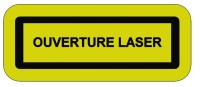
Standard laser aperture label.
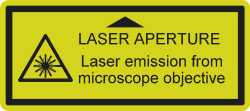
Andor laser aperture label for a microscope stage.
-
The system integrator MUST ensure that the final system’s laser aperture is suitably labelled e.g. the microscope’s objective is identified by a label on the microscope’s stage top.
Access Panels
The following labels are located on panels that should only be opened by our Customer Support Team and which are not interlocked as they are tool-accessible:

Access panel labels.
Laser Product Classification Labels with Explanatory Text
-
Copies of these labels can be found at the beginning of the Laser Safety Special Warnings section.
-
The power values on these labels are intended as maximum values for classification purposes based on IEC 60825-1 Condition 3 (using a 7 mm limiting aperture to simulate the eye’s pupil at a distance of 100 mm from the laser aperture) taking into account future versions of this product and possible failure scenarios. The wavelength range covers all of the possible wavelengths that can be installed in this unit.
-
The actual values of power and wavelength for each of the modules in your version of the product can be found in the documentation accompanying your unit. See also Laser Specifications.
-
Additional classification labels should be affixed to connected products that use laser radiation from this product. If these do not exist, then contact your occupational laser safety department and/or our customer support team to arrange for appropriate labels to be affixed.
CDRH Certification Label
The rear panel label includes the words “Complies with 21 CFR 1040.10 and 1040.11 except for conformance with IEC 60825-1 Ed. 3., as described in Laser Notice No. 56, dated May 8, 2019”. This means that it complies with the U.S. Federal Regulations for laser products as overseen by the Center for Devices and Radiological Health (CDRH), which is part of the Food and Drug Administration (FDA), by means of IEC 60825-1 Edition 3 as allowed by CDRH Laser Notice No. 56, except for some additional requirements as described in that Notice
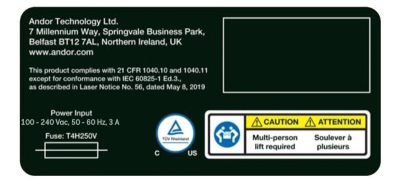
Rear panel label.
Working with Optical Fibres
-
This was installed by our Customer Support Team. For your safety, only they should remove or inspect optical fibres.
-
The laser radiation passing through fibres is potentially hazardous, so great care should be taken to avoid exposure to this radiation.
-
Optical fibres can be easily damaged by bending or general mishandling, and are especially prone to damage by bending close to the connector.
-
Ensure that the minimum bend diameter or radius is never exceeded when handled or coiled.
-
The bend diameter is the diameter of the circle created by coiling the fibre, and the bend radius is half of this and created by the “corners” in your fibre layout.
-
The FOA state that the minimum bend diameter is 40 times the outer diameter (OD) of the cable when under tension or 20 times when not under tension.
-
The Versatile Laser Engine output fibres are all 3 mm OD, so the minimum bend diameter is 120 mm under tension. We recommend that you aim to have a bend diameter of 150 mm or preferably more.
-
The BCU output fibre is 5 mm OD, so the minimum bend diameter is 200 mm under tension. We recommend that you aim to have a bend diameter of 250 mm or preferably more.
-
The coupler is not designed to withstand pulling of the fibre. If the fibre is pulled the system performance could be compromised, the system may fail, or you may even be exposed to hazardous laser radiation.