Global Shutter Internal Triggering (Non-Overlap Mode)
In internal non-overlap modes, a new exposure can not start until the previous exposure has been read out. The exact acquisition sequence depends on the exposure time. The two scenarios are shown in Global Shutter Internal Triggering – Short Exposures and Global Shutter Internal Triggering – Long Exposures. If the exposure time is less than the time it takes to read out a frame, then the exposure period occurs between reading out the reference and the signal frames as shown in Global Shutter Internal Triggering – Short Exposures.
In this scenario, the reference frame is read out before the Global Clear is performed. The negative edge of the Global Clear begins an exposure. After the user-defined exposure time, the Charge Transfer pulse goes HIGH to transfer charge from all pixels in the sensor. The signal frame is then read out.
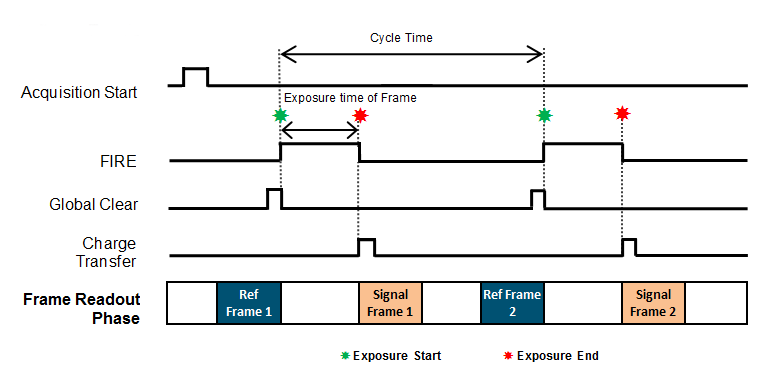
Global Shutter Internal Triggering – Short Exposures
Global Shutter Internal Triggering - Short Exposures Timing Parameters
| Parameter | Minimum | Maximum |
|---|---|---|
| Exposure | 1 Row | 1 Frame + 3 Rows |
| Cycle Time (1/Frame Rate) | Exposure + 2 Frames + 2 InterFrames | Exposure + 2 Frames + 2 InterFrames |
| Acquisition Start Delay | 0 | 1 Frame |
If the exposure time is greater than a frame read out time, the exposure starts first by pulsing the Global Clear. The reference frame is read out during the exposure such that the end of the reference read out is coincident with the end of the exposure. The Charge Transfer pulse then goes HIGH to transfer charge from all pixels in the sensor. Finally, the signal frame is then read as shown below.
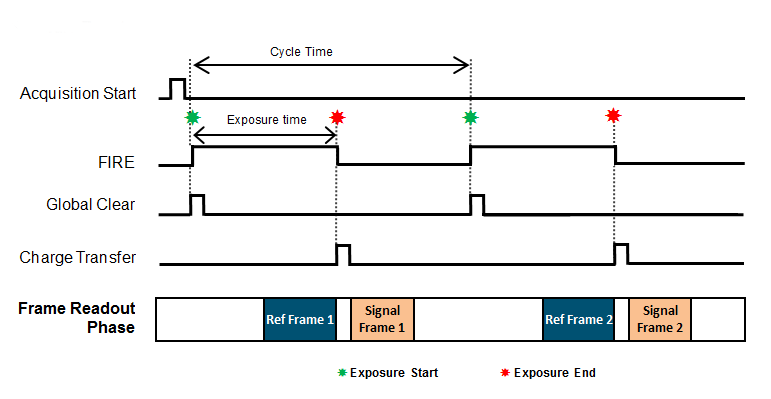
Global Shutter Internal Triggering – Long Exposures
Global Shutter Internal Triggering - Long Exposures Timing Parameters
| Parameter | Minimum | Maximum |
|---|---|---|
| Exposure | 1 Frame + 4 Rows | 30 s |
| Cycle Time (1/Frame Rate) | Exposure + 1 Frames + 1 InterFrame + 6 Rows | 20,000 s |
| Acquisition Start Delay | 0 | 1 Row |