Global Shutter External Exposure Triggering (Overlap Mode)
In overlap mode, every positive edge of an External trigger will trigger a signal frame read out and start a new exposure. The period of External trigger pulse defines both the exposure time and cycle time. Note that when an acquisition starts, the first positive edge of the trigger will initiate the first exposure but also output a frame that has an incorrect exposure which is therefore discarded. The next positive edge of the trigger will end the first exposure and start a new frame read out. From the figure below, it is can be seen that the minimum exposure time is approximately two frame read out periods. The first read out period is used to read out the “Signal” frame while the second is used to read out the “Reference” frame for the subsequent “Signal” frame.
If the period of the external trigger is less than the minimum period discussed above any positive edge occurring during the “Signal” and “Reference” frames will be ignored. The ARM signal indicates when positive going edges will be accepted.
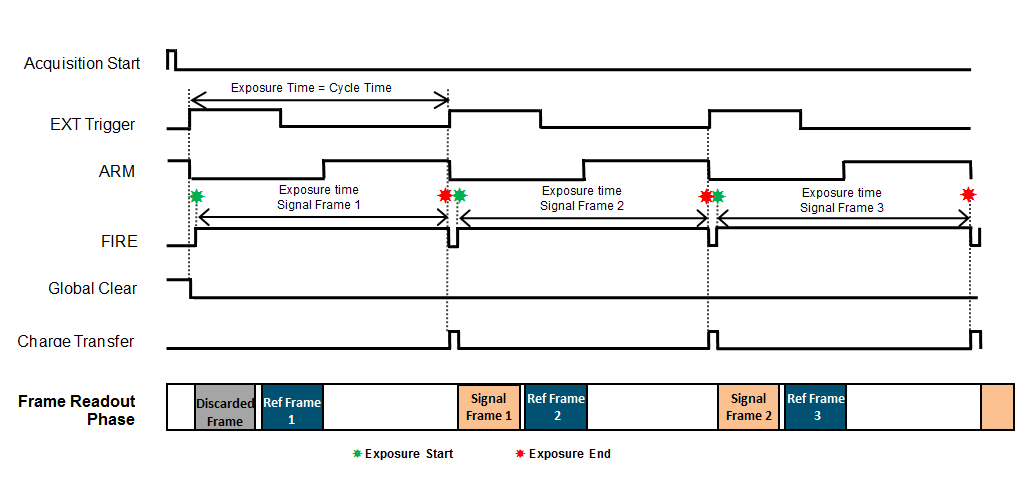
Global Shutter External Exposure Triggering (Overlap Mode)
Global Shutter External Exposure (Overlap Mode) Timing Parameters
| Parameter | Minimum | Maximum |
|---|---|---|
| Exposure (EXT Trig Pulse Width) | 2 Frames + 2 InterFrames | 30 s |
| Cycle Time ( EXT Trig Period) | 2 Frames + 2 InterFrames | 30 s |
| External Start Delay (1st Frame Only) | 0 | 1 Row + Charge Transfer Time |
| External Start Delay (Frame #2... Frame #n) | Charge Transfer Time | Charge Transfer Time |
| EXT Trig Pulse Width | 2 Sensor Speed Clock Cycles | - |
| Note |
|---|
| In global shutter external exposure mode, taking exposures in darkness of 270 ms or more will lead to increased noise. A reference frame is taken at the start of the exposure and the camera then idles until the end is signalled, which triggers the image readout. The increased noise is coming from the separation of the reference frame and the image frame. This is less prominent with deeper cooling. |